
Graph neural networks for drug discovery
Top 13 of 370+ global participants, macro-averaged RAE 0.588
- CSIRO Manufacturing
- 2025
- Machine learning
Multi-task GNNs that predict pharmacokinetic (ADME) properties to speed up drug screening.
Project information
- CSIRO Manufacturing
- 2025
- PyTorch, Chemprop, RDKit, SLURM, HPC
- Top 13, of 370+ global participants, macro-averaged RAE 0.588
The problem
Screening drug candidates in the lab is slow and expensive. If a model can predict a molecule’s pharmacokinetic properties up front, chemists can spend lab time on the candidates most likely to succeed.
Approach
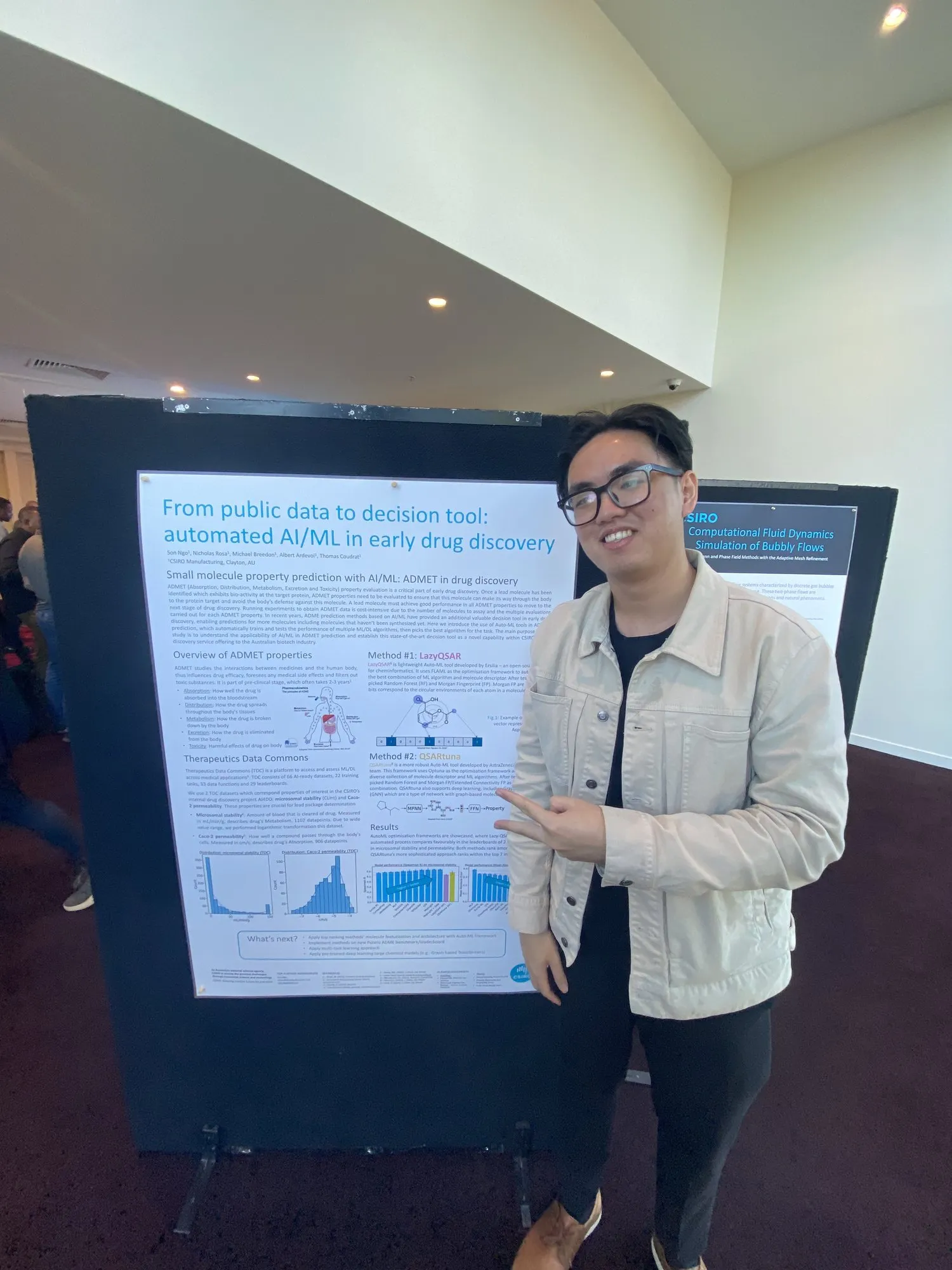
At CSIRO I developed and evaluated an AI application that predicts these properties, and entered the approach in the OpenADMET and ExpansionRx blind challenge.
- Graph representations. Molecules are featurised as graphs and modelled with Chemprop message-passing networks. I also experimented with adding fingerprint features (Morgan, Avalon, ErG and MACCS).
- Multi-task learning. The model learns all endpoints jointly, supplemented with public datasets (Galapagos’ Polaris set and a merged Novartis set of roughly 300K molecules) after chemical curation and SMILES canonicalisation.
- Target transforms. Skewed endpoints are log-transformed, with a logit transform for percentage endpoints.
- Ensembling. Models are trained on five random splits and the submission averages all five checkpoints.
- Tuning at scale. Training and hyperparameter search ran on HPC with SLURM. Hand-picked hyperparameters ended up beating automated Tree-structured Parzen Estimator search.
Results
- Top 13 of 370+ global participants.
- 0.588 macro-averaged relative absolute error.
Working across disciplines
The work was shared with AI, chemistry and bioengineering teams to judge practical applicability, with findings written up as technical reports for stakeholders.
Top 13of 370+ global participants, macro-averaged RAE 0.588